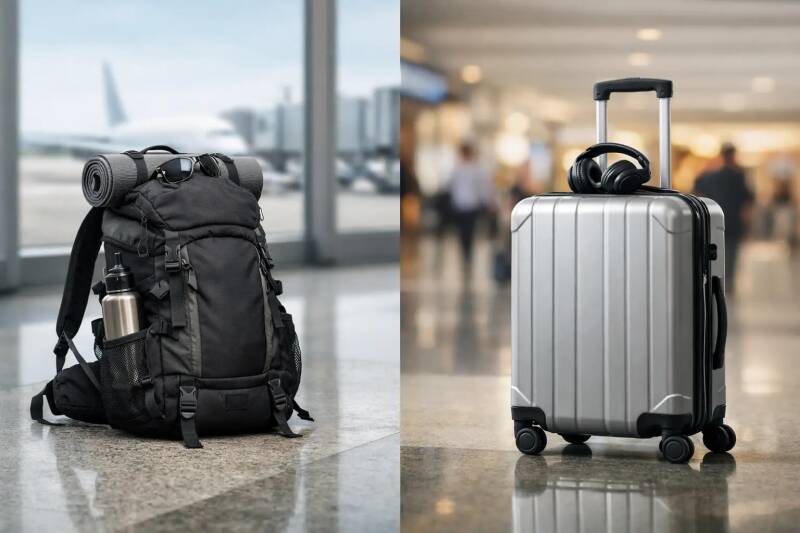
Travel backpack vs suitcase - learn which one fits your trip, budget, style, and comfort so you pack smarter and avoid common travel mistakes. You feel the difference before you even leave the airport. One traveler is dragging a hard-shell case over cobblestones, lifting it up staircases, and apologizing while blocking a narrow train aisle. Another has a backpack on, hands free, walking straight to the exit. That is why the travel backpack vs suitcase question matters more than people think. Your luggage does not just carry your stuff. It shapes how you move, what you bring, and how stressed or flexible you feel once the trip actually begins.
I have traveled with both, and I would never pretend one is always better. The right choice depends on where you are going, how often you will change locations, what kind of accommodation you are using, and how much comfort you want between transit points. If you are trying to travel lighter, spend less, and move through a place with more ease, this decision can quietly change the whole rhythm of your trip.
Travel backpack vs suitcase: what changes on the road
The biggest difference is mobility. A suitcase works best when your trip has smooth surfaces, short transfers, and stable accommodation. If you are flying into one city, taking a cab to a hotel, and unpacking for a week, a suitcase is often the easier and tidier option. Everything is visible, structured, and simple to access.
A travel backpack comes into its own when the journey is less polished. Think uneven sidewalks, hostels without elevators, train platforms with no ramps, ferry docks, buses with tight luggage holds, or guesthouses hidden down side streets. In those moments, carrying your bag on your back can feel less like a style choice and more like a small act of self-preservation.
There is also a mental difference. Suitcases invite you to pack as if you are moving in. Backpacks tend to keep you honest. When you have to carry every extra item on your shoulders, you quickly learn what you actually need.
When a suitcase makes more sense
Suitcases are not the villain of budget or meaningful travel. In some cases, they are the smarter tool. If you are traveling for a wedding, a work trip, or anywhere you need structured clothing, a suitcase protects pressed outfits and formal shoes better than most backpacks. If you are traveling with children, carrying a backpack plus kid gear can become too much. If you have mobility issues, rolling a case may be far easier than carrying weight on your body.
They are also better for longer stays. If you are renting one apartment for ten days in Lisbon, Mexico City, or Tokyo and using it as a base, a suitcase can make daily life easier. You unpack once, keep things organized, and stop thinking about your bag.
I also think suitcases suit travelers who feel anxious about packing. The clamshell opening, compartments, and familiar shape can make trip prep feel more manageable. There is no prize for choosing a backpack if the result is sore shoulders and a constant sense of irritation.
Best trips for a suitcase
A suitcase usually works well for city breaks, road trips, business travel, resort stays, family vacations, and any trip where you will spend most of your time in one place. It is especially useful when airports, hotels, and taxis do most of the heavy lifting.
When a travel backpack is the better choice
A backpack is usually the better fit for multi-stop travel. If you are moving every few days, catching trains, staying in hostels, taking budget airlines, and walking part of the way to your accommodation, a backpack gives you freedom that a suitcase often does not.
It is also ideal for solo travel. That hands-free feeling matters when you are juggling a phone, passport, water bottle, and Google Maps while trying to find the right exit in a station you have never seen before. You can move faster, keep closer to your body in crowds, and manage stairs without turning luggage into a public performance.
There is a budget angle too. Backpack travelers often pack more minimally, which helps avoid checked bag fees, oversized purchases, and the habit of bringing "just in case" items. It will not magically make your trip cheap, but it can remove some of the small costs and inconveniences that add up.
Best trips for a backpack
A travel backpack shines on backpacking routes, gap year trips, hostel-heavy itineraries, island hopping, train travel, and any journey where unpredictability is part of the appeal. If your trip includes rough pavement, shared transport, or frequent location changes, a backpack is often the more forgiving option.
Comfort is not just about weight
A lot of people assume wheeled luggage is automatically easier because you are not carrying it. Sometimes that is true. But only on the right terrain. The minute the wheels stop gliding, the suitcase becomes dead weight in one hand. Curbs, gravel, stairs, cracked sidewalks, and busy platforms turn rolling luggage into lifting luggage very quickly.
That said, backpacks have their own problem. A poorly fitted one can make your neck, shoulders, and lower back miserable. If you choose a backpack, fit matters as much as size. Look for padded shoulder straps, a supportive hip belt if the bag is larger, and a shape that sits close to your body rather than sagging away from it.
This is where honest self-knowledge matters. If you know you overpack, a backpack may punish you. If you know your route includes old towns, ferries, and station stairs, a suitcase may punish you. The better bag is the one that matches the friction points of your trip.
Packing style matters more than people admit
Suitcase people and backpack people often pack differently because the bag itself encourages a certain behavior. Suitcases make it easier to separate outfits, bring bulkier items, and keep souvenirs safe on the way home. That is useful if you like options, need weather flexibility, or plan to shop.
Backpacks reward compact thinking. You roll clothes tighter, choose layers instead of heavy pieces, and become more selective about shoes. I have found this usually leads to better travel decisions overall. You do laundry once or twice, repeat outfits without drama, and stop carrying things for imaginary situations.
Still, minimalism is not morally superior. If a suitcase helps you feel prepared, polished, and less stressed, that confidence has value too.
Security and practicality on transit days
Neither option is perfectly secure. A suitcase can be locked and is harder to pick through casually, but it is also more likely to be checked, stored away from you, or separated from your line of sight on buses and trains. A backpack stays closer to you, though external pockets can be vulnerable if you are not paying attention.
For many travelers, the real practical question is access. Suitcases are easier to open and repack neatly. Backpacks can turn into fabric caves if they only load from the top. If you choose a backpack, a front-loading design makes a huge difference. It gives you some of the organization of a suitcase without losing mobility.
So, should you choose a backpack or a suitcase?
If your trip is fast-moving, flexible, budget-conscious, and built around public transportation, I would choose a travel backpack most of the time. It suits the kind of travel where you care more about freedom than perfect outfit preservation. It helps when your days include walking, waiting, adjusting, and saying yes to plans that were not on your original itinerary.
If your trip is slower, more settled, or centered on comfort and structure, a suitcase is often the better choice. It keeps packing simple, protects your belongings well, and works beautifully when your travel days are straightforward.
For a lot of travelers, the answer is not ideological. It is situational. I have used a backpack for Southeast Asia, intercity rail trips, and solo hostel stays where I knew I would be moving often. I have used a suitcase for longer city stays and trips where I wanted to carry less on my body and unpack properly once I arrived.
At PackLight Journeys, we come back to the same idea again and again: the best travel gear is the gear that supports the trip you actually want. Not the fantasy version with perfect airport floors and endless patience. If you picture your route clearly - the stairs, the sidewalks, the buses, the hotel room, the laundry plan, the pace - your answer usually becomes obvious.
Choose the bag that lets you move through the world with less friction and more attention for what you came to experience.
Add comment
Comments