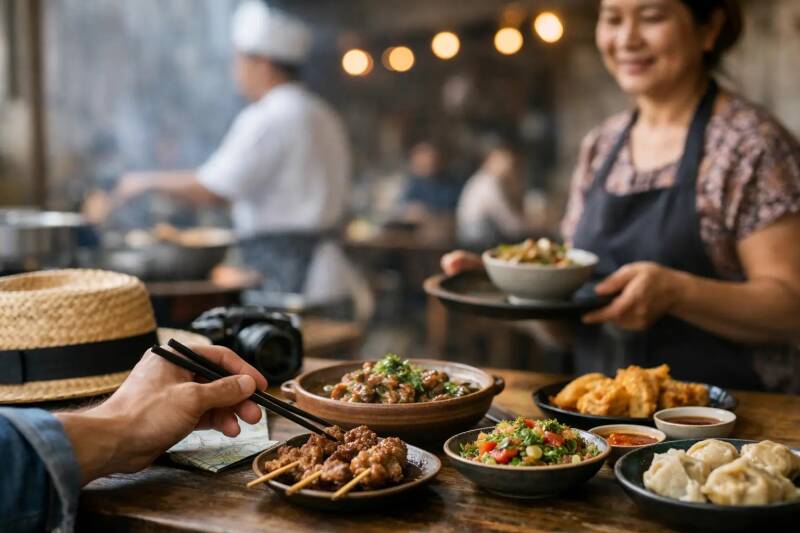
Learn how to find authentic food experiences while traveling with smart, budget-friendly tips that lead to local meals and real cultural connection. You can learn a lot about a place from its landmarks, but you understand it faster over a plastic stool, a chipped plate, and a dish someone has been making the same way for twenty years. If you want to find authentic food experiences, start by letting go of the idea that the "best" meal is always the most famous one. Often, the meals you remember most are the ones that came with a conversation, a wrong turn, and a little trust in the neighborhood around you.
I have eaten unforgettable food in polished dining rooms, but the meals that stayed with me were usually quieter. A bakery at 7 a.m. with construction workers lined up outside. A family-run lunch spot with one handwritten menu and no English translation. A market stall where I pointed, smiled, and ended up with something far better than what I had planned. Authentic food is not about chasing a performance of local culture. It is about finding places where food is still part of everyday life.
What authentic food experiences actually look like
This matters because a lot of travelers look for authenticity in the wrong places. They search for "hidden gems," follow a dozen viral recommendations, and end up in rooms full of other visitors doing the exact same thing. The food may still be good, but there is a difference between popular and rooted.
An authentic food experience usually has a few signals. The place serves people who live nearby. The menu reflects local habits, ingredients, or seasons instead of trying to please every possible tourist. The staff are not performing a story about the food for social media. They are simply getting through a busy lunch rush, wrapping dumplings, slicing roast meat, pouring coffee, or arguing kindly over whose turn it is to clear the table.
That does not mean authentic always equals cheap, rustic, or unknown. A famous noodle shop can still be authentic if it remains connected to local life. A polished restaurant can still tell a true story about regional cooking. The point is not to avoid every place with a guidebook mention. The point is to ask whether the experience feels grounded in the place, or built mainly for visitors passing through.
How to find authentic food experiences before you go
The best food research starts before the flight, but not with a top ten list. I like to begin by learning what people in that destination actually eat for breakfast, lunch, late-night snacks, and celebrations. That small shift changes everything. Instead of searching for the single most iconic restaurant, you begin looking for food habits.
Search neighborhood by neighborhood, not citywide. Big cities can flatten into one generic list of must-eats, and that is how you miss the places locals return to every week. Look for markets, commuter districts, university areas, and residential streets near transit rather than tourist squares. If a destination has a dish everyone knows, research regional variations and where people debate the best version. That usually leads you to places with stronger local loyalty.
It also helps to check local opening rhythms. Some of the most authentic spots are only open for breakfast, only serve lunch until they sell out, or close two days a week with no explanation that makes sense to outsiders. If you build your food plans around flexible windows instead of one overplanned dinner reservation every night, you will have much better luck.
The simplest signs you are in the right place
Once you arrive, the best clues are often ordinary. Look for restaurants where people are eating at odd hours, not just prime dinner time. Look for short menus, fast turnover, and staff who assume you already know how things work. That last one sounds intimidating, but it is often a good sign. It means the place exists for regulars first.
I also pay attention to what is missing. If every dish has a photo, every staff member speaks the same sales script, and the menu offers pizza, burgers, sushi, and pad thai in one place, you are probably not looking at a kitchen focused on local identity. Convenience is not a crime, and sometimes convenience is exactly what you need, especially after a long travel day. But if your goal is cultural connection, you will usually find more of it in places that do fewer things well.
Markets are another strong starting point, though they require a little patience. Some stalls are there for visitors, some are there for everyone, and some do both beautifully. The trick is to watch before you order. See where older shoppers stop. See which stands have repeat customers. Notice whether vendors are selling ingredients locals are actually buying for home cooking as well as ready-to-eat food.
Ask better questions if you want better meals
One of the easiest ways to find authentic food experiences is to stop asking, "Where should I eat?" and start asking more specific questions. Hotel staff, taxi drivers, baristas, walking tour guides, and shop owners can all help, but the quality of the answer depends on the question.
Ask where they eat on a normal Tuesday. Ask where they take a friend visiting from another part of the country. Ask where to go for one dish done really well. Ask what is worth trying in the morning versus at night. If you are on a budget, say that clearly. People are usually better at recommending places when they know your style and price range.
I have had especially good luck asking food vendors where they eat when they are not working. A baker who points you to a noodle shop, or a fruit seller who sends you to a breakfast counter nearby, is often giving you a recommendation built on routine rather than trend.
Use social media carefully, not blindly
Social platforms can help, but they can also flatten a food scene within months. A place goes viral, lines form, prices rise, and suddenly the meal is more about documenting that you got in than enjoying what is on the plate.
That does not mean you should avoid social media entirely. It means you should use it like a map, not a command. Look beyond the most viewed posts. Search in the local language when possible. Pay attention to who is posting. A local food writer with modest engagement may lead you somewhere far better than a creator filming dramatic cheese pulls for millions of viewers.
Reviews need the same caution. A low score does not always mean bad food. It may mean blunt service, no substitutions, cash only, or a menu that confused tourists. Those things can frustrate travelers, but they are not proof that the place is poor. Read for patterns, not stars.
Respect is part of the experience
Authentic food experiences are not something you extract from a place. They happen when you participate with respect. Learn a few food words before you go. Know how tipping works. Understand whether lingering at a table is normal or inconsiderate. If there is a line, watch the flow before stepping in. If the menu is unfamiliar, be open rather than defensive.
This matters even more in small family-run places, where one awkward interaction can shape the whole exchange. You do not need perfect language skills. A little humility goes a long way. So does accepting that sometimes you will order the wrong thing, misunderstand the system, or eat something that is just okay. That is part of real travel too.
There is also a budget angle here. Some of the most meaningful meals are affordable precisely because they serve everyday needs rather than visitor expectations. If you travel the way we often encourage at PackLight Journeys - lighter, slower, and with room for detours - you create space for those meals to happen.
When touristy food is still worth it
Not every well-known place is a trap, and not every local place will suit you. Sometimes the famous food market is famous for good reason. Sometimes the old institution packed with visitors still serves a brilliant version of a classic dish. Sometimes you are tired, overwhelmed, and just want the easy option with a clear menu and decent air conditioning. That is fine.
The better goal is not purity. It is balance. Have the iconic meal if you want it. Then make room for the corner spot near your guesthouse, the market breakfast, the bakery line, the neighborhood lunch counter. One gives you context, the other gives you texture.
If you chase only authenticity, travel can become strangely performative, as if every meal has to prove something. The sweetest food memories usually come when you stay curious without turning dinner into a test.
Let the meal change your day
The best food experiences often come from rearranging your schedule around how a place eats. Wake up early for the market. Take the long walk to the lunch spot. Skip one overbooked attraction so you can sit a little longer over soup, coffee, or grilled fish while the afternoon moves around you.
That is where food stops being a checklist item and starts becoming a way into the place itself. You notice more. You talk more. You remember more. And long after the trip ends, you may forget the price of the ticket or the name of the square, but you will remember the steam rising from a bowl handed across a counter and the small feeling that, for an hour, you were exactly where you were meant to be.
Add comment
Comments