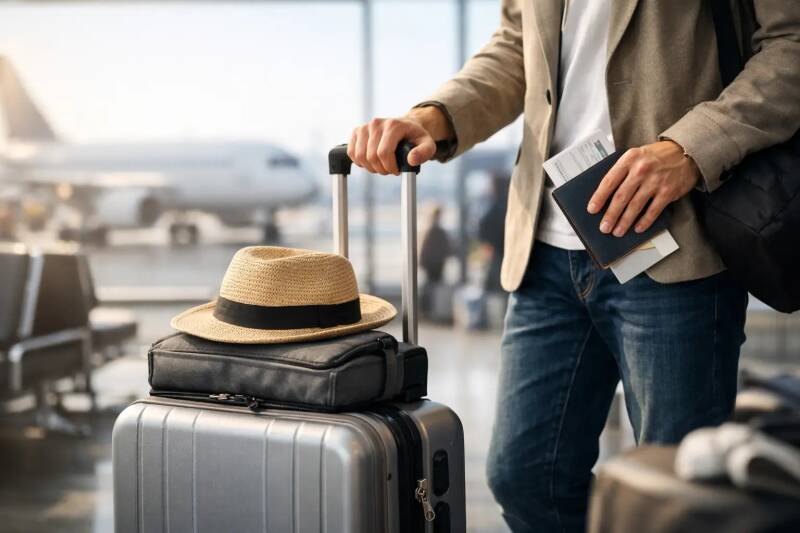
Travelling with only hand luggage saves money, time, and stress. Learn what to pack, what to skip, and how to make cabin-only trips work. You feel it at the baggage carousel first - that small, sinking frustration of waiting under fluorescent lights while your trip is already happening somewhere beyond the sliding doors. Travelling with only hand luggage cuts that part out entirely. You land, walk, and go. No lost suitcase, no extra baggage fees, no hauling half your closet over cobblestones because you packed for every possible version of yourself.
I did not always travel this way. I used to pack for mood swings, weather shifts, and imaginary emergencies. Then a few trips taught me the obvious truth: the lighter I traveled, the more present I became. When your bag fits above your seat, your decisions get clearer, your transit days get easier, and you stop treating travel like a relocation project.
Why travelling with only hand luggage changes the trip
The practical benefits are easy to name. You usually save money, move faster through airports, and avoid the risk of checked bags going missing. If you are taking trains, buses, ferries, or budget flights, a small bag also makes every transfer less tiring.
But the bigger shift is mental. A smaller bag forces better choices. You pack what you will actually wear, not what makes you feel vaguely prepared. You stop carrying backup outfits for dinners that may never happen and extra shoes that hurt your shoulders more than they help your plans. That kind of editing is useful because it matches the best kind of travel - flexible, curious, and focused on experience rather than stuff.
There is a trade-off, of course. Hand-luggage-only travel asks for discipline. You may need to rewear clothing, do laundry mid-trip, and let go of the idea that every photo needs a different outfit. For some trips, especially weddings, winter travel, or technical adventure travel, cabin-only packing can feel tight. Still, for many city breaks, multi-stop journeys, and longer budget trips, it is more realistic than people think.
Start with the airline, not the packing list
Before you fold a single T-shirt, check the exact baggage rules for your airline. This is where many travelers get caught out. One carrier calls it a carry-on, another calls it a cabin bag, and the measurements can vary more than you expect. Some budget airlines are strict enough that the wrong bag shape can cost more at the gate than your flight did.
I always treat airline limits as the foundation, not a suggestion. Size matters, but weight matters too, especially outside the US. A bag that technically fits the dimensions can still create problems if it is too heavy to lift easily or exceeds the limit at check-in.
If you travel often, it is worth choosing one soft-sided bag or compact backpack that works across multiple airlines. Hard-shell cases can be great, but a soft bag gives you more flexibility when overhead bins are crowded or measurements are close.
The real secret is packing for one week, even on a longer trip
The most useful mindset for travelling with only hand luggage is this: pack for seven days or less, then wash and repeat. Once you accept that you are building a rotation rather than a full wardrobe, everything gets simpler.
For most trips, that means a small set of tops, a couple of bottoms, underwear and socks for around a week, sleepwear, one light layer, and one weather-specific outer layer. Shoes are where bags become heavy fast, so I usually stick to one pair worn in transit and one compact backup if the trip truly needs it.
The best travel clothes are not always the most technical. They are the ones you reach for without thinking because they layer well, dry reasonably fast, and work in more than one setting. Neutral colors help, but this does not mean dressing blandly. It means choosing pieces that cooperate with each other so you are not packing outfits that only work once.
What deserves space in your bag
The winners are items with range. A shirt that works for a museum day and dinner. Pants that can handle a train ride and a long walk. A lightweight sweater that helps with chilly flights and cool evenings. Multi-use items earn their place because they reduce the total number of things you need.
Toiletries also need that same ruthless logic. Travel sizes are obvious, but solids matter even more. Shampoo bars, conditioner bars, sunscreen sticks, and a compact soap case save liquid allowance and reduce the chance of leaks. If you are staying in cities, remember that most forgotten basics can be bought when you arrive.
What usually does not deserve space
The common bag-fillers are "just in case" clothes, full-size toiletries, bulky electronics, and too many shoes. I would add sentimental packing to that list too - the extra dress you bring because maybe this trip is the moment for it, or the book so heavy it changes the shape of your bag. Some trips are aspirational enough already. Your luggage does not need to be.
How to make a small bag feel bigger
The method matters almost as much as the items. Rolling works for some travelers, but I prefer a mix of folding and compression. Packing cubes are useful because they create boundaries. One for tops, one for bottoms, one for underwear, one for miscellaneous items. The magic is not just neatness. It is visibility. You can see what you packed and stop adding things blindly.
Wear your bulkiest items in transit. That usually means your jacket, heaviest shoes, and any sweater that takes up real space. Keep your personal item for essentials you want during the journey: passport, charger, medication, headphones, water bottle, and one layer for the plane.
Leave a little room if you can. A bag packed to absolute capacity is harder to repack, more stressful at security, and less forgiving if you pick up a snack, a local food gift, or a small market find on the road.
Laundry is not failure
A lot of resistance to hand-luggage-only travel comes down to one idea: people think doing laundry somehow means they packed badly. I see it differently. Washing a few items during a trip is often the smartest trade you can make.
Sink laundry works for short trips and light fabrics. For longer journeys, I look for accommodations with a washer, nearby laundromats, or simple wash-and-fold services. It is often cheaper than checking baggage and far less annoying than carrying two weeks of clothing on your back.
This is especially true if you are moving between places. On a multi-city trip, the freedom of carrying your whole life in one small bag is hard to overstate. You can walk from the train station to your guesthouse without dreading every staircase.
Hand luggage works best when your trip has a clear shape
Not every trip asks for the same strategy. A long weekend in Lisbon, a two-week solo trip through Japan, and a cold-weather trip to Iceland all have different packing realities. The trick is not forcing the same formula every time. It is understanding what your trip actually demands.
If your journey includes formal events, hiking gear, or major weather extremes, you may need to get more selective or accept one checked bag. There is no medal for suffering in the name of minimalism. The point is to carry less where it genuinely improves the experience.
For most travelers, the sweet spot is simple: know your itinerary, check the forecast, and pack for the version of the trip you are actually taking. Not the fantasy version. Not the fear-based version. The real one.
The confidence part no one talks about
Travelling with only hand luggage can make you feel surprisingly capable. It removes friction at every stage, but it also teaches trust - in your own judgment, your adaptability, and your ability to solve small problems without packing your entire home.
That is part of why this style of travel suits meaningful trips so well. When you carry less, you notice more. You are less busy managing your stuff and more available for the things that tend to matter later: the late lunch that turns into a conversation, the walk you took because it was easier than dragging a suitcase, the last-minute change of plan you said yes to because you were free to move.
At PackLight Journeys, that has always felt like the deeper point of packing light. It is not about proving how little you need. It is about making space for the trip itself.
So if you are tempted to try travelling with only hand luggage, start with one journey, not a grand vow. Pick the easier trip. Test your bag. Learn what you miss and what you never touch. Then go lighter again next time. The more confidently you carry less, the more room travel has to surprise you.
Add comment
Comments