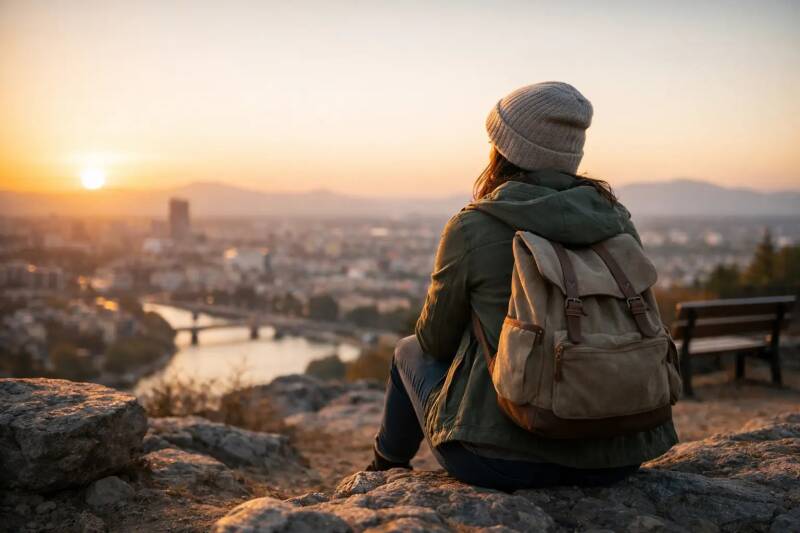
Is solo travel lonely? Sometimes, yes - but often it's freeing, social, and deeply rewarding. Here's what loneliness looks like and how to handle it. The loneliest moment I have ever had while traveling alone was not on a remote mountain trail or a night bus in a country I barely understood. It was at a perfectly nice cafe, surrounded by conversation, watching groups pass plates back and forth while I sat with a coffee and too much time in my own head. So if you're asking, is solo travel lonely, the honest answer is yes, sometimes. But that is only part of the story.
Solo travel can feel expansive one hour and sharp-edged the next. You can wake up thrilled by your own freedom, then feel a little hollow by dinner. That emotional swing is normal. It does not mean you are bad at traveling alone, and it does not mean solo travel is the wrong choice for you.
Is solo travel lonely, or just quieter?
A lot of people confuse loneliness with quiet. They are not the same thing.
Quiet is eating breakfast alone and enjoying the slow start. It is choosing a museum because you want to linger, or changing your plans without a group debate. Quiet can feel calm, observant, and deeply satisfying. For many travelers, that is one of the best parts of going solo.
Loneliness is different. It usually shows up as a sense of disconnection. You might have a beautiful day and still wish there were someone beside you to laugh with about the wrong train, the incredible street food, or the awkward language mix-up that somehow worked out. The trip can still be good. You can still be grateful. But a few moments may feel emotionally flat because no one close to you is there to witness them.
That distinction matters because it changes what you do next. If you are simply adjusting to more silence, you may need time. If you are truly lonely, you may need connection.
Why solo travel can feel lonely sometimes
Travel strips away your normal routines, and routines are often where connection hides. At home, you may not think much about your barista remembering your order, your roommate in the kitchen, or the friend who texts you on the train. On the road, especially in a new place, that social fabric disappears overnight.
There is also the pressure of expectation. Solo travel is often sold as empowering, life-changing, and endlessly photogenic. Some of it is empowering. Some of it is life-changing. But there are also evenings when you are tired, overstimulated, and just want someone familiar to tell you the day made sense. When your real emotions do not match the fantasy, loneliness can feel heavier than it otherwise would.
Certain situations make it more likely too. Long transit days, Sundays when cities feel slower, arrival days in unfamiliar places, and meals at odd hours can all magnify isolation. Social media does not help. If you are looking at everyone else's curated group adventures while sitting in a hostel common room feeling awkward, your brain will fill in the gaps with stories that are not always true.
When solo travel feels most rewarding
The strange thing is that the same trip that makes you lonely can also make you feel more alive than you have in months.
Traveling alone heightens your attention. You notice the smell of bread drifting out of a bakery at 7 a.m. You hear snippets of local conversation. You look up more. Without the buffer of familiar company, the world comes at you more directly. That can be tiring, but it can also be beautiful.
There is also a confidence that builds slowly and then all at once. You navigate a station, solve a booking issue, find a neighborhood market, and realize you are more capable than you thought. That kind of self-trust is hard to manufacture at home. It grows through small decisions repeated across unfamiliar days.
And perhaps most surprisingly, solo travel can be social in ways group travel often is not. When you are alone, people approach you more easily. You are more likely to talk to the person next to you on a food tour, join a hostel dinner, or accept an invitation to explore a local market. You become more available to chance.
How to make solo travel less lonely
You do not have to choose between total independence and emotional survival. The best solo trips usually have a little structure around connection.
Start with where you stay. If loneliness worries you, book accommodations designed for light social contact, not just the cheapest bed. A small guesthouse with a communal breakfast, a well-reviewed hostel with common spaces, or a locally run stay where the host likes to chat can make a huge difference. Privacy matters, but atmosphere matters too.
Plan one connective thing into each day. That could be a walking tour, a cooking class, a language exchange, a group hike, or simply returning to the same coffee shop. Repeated contact creates familiarity, and familiarity makes a place feel less anonymous.
Food is another powerful fix. Eating alone can feel elegant one day and bleak the next, so vary the format. Sit at counters when you can. Visit markets. Book a food tour early in your trip. Shared eating lowers social barriers quickly, and it gives you something immediate to talk about.
It also helps to stay in touch with home without clinging to it. A check-in call with a friend can ground you, but spending every spare minute messaging people back home can keep you half-absent from where you are. Aim for connection that steadies you, not connection that prevents you from arriving emotionally in the place.
What first-time solo travelers often get wrong
Many first-time solo travelers assume they need to prove something. They think the trip only counts if they love every minute of it, make instant friends, and never feel uncomfortable. That is a fast route to disappointment.
A better approach is to treat solo travel as a skill, not a personality trait. Some people take to it instantly. Others grow into it. You may be confident in one destination and lonely in another. You may love solo city breaks but dislike long stretches in remote areas. None of that means you have failed. It just means you are learning how you travel best.
Another common mistake is overloading the itinerary. People try to outrun loneliness by keeping every hour full. Busy days can help, but constant motion can become its own kind of exhaustion. A better balance is to build in anchor points: one meaningful activity, one practical task, one good meal. Leave room for spontaneity without leaving the whole day emotionally unstructured.
Is solo travel lonely for introverts or extroverts?
Both, just in different ways.
Introverts often enjoy the autonomy of solo travel, especially the freedom from compromise and social overexposure. But they may struggle if they isolate too much and let small discomforts go unspoken for days. Extroverts may meet people more easily, yet feel the absence of familiar companionship more intensely when casual conversations do not turn into real connection.
This is why personality is only part of the equation. Travel style matters more. An introvert who books community-oriented stays and a few shared activities may feel great. An extrovert who spends three nights in a silent business hotel on the edge of town may feel miserable. Knowing what restores you is more useful than labeling yourself.
The honest answer: yes, and that is not always bad
There is a version of loneliness that simply hurts. If your trip feels consistently isolating, anxious, or emotionally draining, change something. Move accommodations. Join a tour. Call someone. Go where people are. Solo travel should stretch you, not flatten you.
But there is another version that has something to teach. Sometimes being alone in a new place reveals how much noise you usually live with. It shows you what comforts you, what scares you, and how much of your identity is tied to other people's presence. That can feel tender before it feels freeing.
At PackLight Journeys, we believe meaningful travel is not always polished. Sometimes the hard moments are the ones that sharpen your memory and deepen your confidence. Not because suffering is noble, but because honest travel leaves room for the full range of being human.
So, is solo travel lonely? Sometimes, absolutely. It can also be social, empowering, restful, awkward, exhilarating, and unexpectedly moving, often within the same day. The goal is not to avoid every lonely moment. The goal is to know that a lonely moment does not define the trip, and it certainly does not define you.
If you are thinking about traveling alone, do not wait until you are fearless. Go with a little self-awareness, a flexible plan, and permission to feel what you feel. Very often, the connection you are looking for starts there.
Add comment
Comments