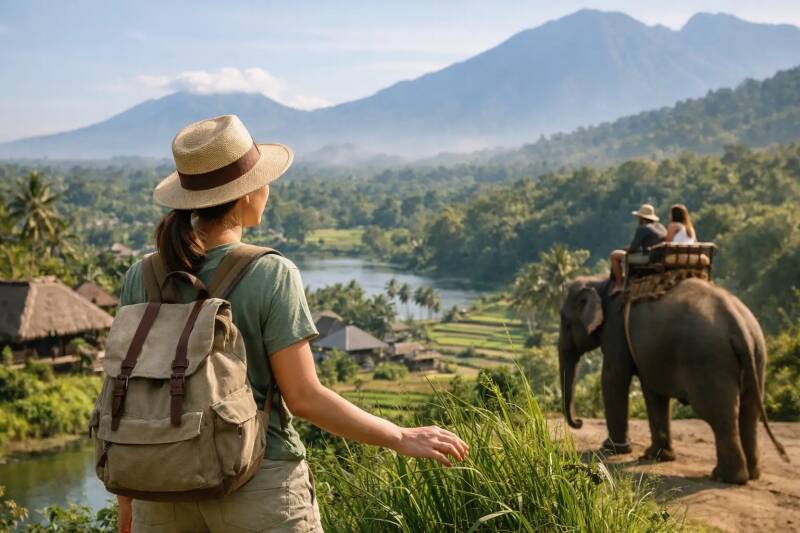
Learn responsible tourism while travelling with practical ways to spend smarter, respect local culture, reduce waste, and leave places better. You can spot the difference between a trip that only consumes a place and one that truly meets it. It shows up in small choices - where you sleep, who you pay, how loudly you move through a neighborhood, whether you treat a market as a backdrop or a conversation. Responsible tourism while travelling is not about being a perfect visitor. It is about noticing that your presence has weight, and choosing to make that weight lighter, kinder, and more useful.
I think this matters most when travel is finally feeling more accessible. Budget airlines, remote work, and endless itinerary content have made it easier than ever to go farther. That is exciting, and it should be. But cheap flights and easy booking also make it easy to move through places without asking what our money supports, what our photos flatten, or what local life looks like once the visitors leave for dinner.
What responsible tourism while travelling actually means
At its core, responsible tourism means trying to leave a place socially, culturally, environmentally, and economically better off, or at least no worse, because you visited. That sounds lofty, but in practice it is ordinary. You choose the family-run guesthouse over the faceless chain when the price difference is reasonable. You learn how people dress at religious sites before showing up in shorts and a crop top. You buy the snack from the local bakery instead of defaulting to the nearest international coffee chain.
The useful thing about responsible tourism while travelling is that it is less about labels and more about behavior. A luxury eco-lodge can still be disconnected from the community around it. A budget backpacker can still be extractive if they bargain aggressively over a few dollars in a country where that money matters. On the other hand, a modest trip with thoughtful choices can create real value for local people while giving you a better, more grounded travel experience.
Start with your money, because your money votes
If you want one principle to remember, make it this: where your money goes shapes the kind of tourism that grows. Every booking nudges the local economy in one direction or another.
That does not mean you need to spend big. Responsible travel is not reserved for people with boutique-hotel budgets. In fact, some of the best choices are budget-friendly. Public transportation often has a lower impact than private transfers and gives you a more honest feel for a place. Eating at neighborhood spots is usually cheaper than tourist-heavy restaurants and often far better. Buying directly from makers at craft markets can put more money into the hands of the person who actually made the item.
It helps to ask a few simple questions before you book. Is this business locally owned or at least locally staffed? Does it seem to respect the area, or does it market the destination like a theme park? Are workers visible in a dignified way, or hidden behind polished branding? You will not always get perfect answers, and sometimes your budget or timing will limit your options. Still, even imperfect effort is better than blind convenience.
Cheap is not always a bargain
One of the hardest truths for budget travelers is that the absolute cheapest option can come with hidden costs. A rock-bottom tour price may depend on underpaid labor, overcrowded sites, rushed wildlife encounters, or forced shopping stops that pressure local vendors. A very cheap apartment rental can also contribute to housing pressure in neighborhoods where long-term residents are already being pushed out.
This is where trade-offs matter. Sometimes a chain hotel may actually be the more reliable ethical choice in a place where short-term rentals are straining local housing. Sometimes a group tour is better than piecing together a fragile environment through multiple private drivers and ad hoc bookings. Responsible decisions are rarely about looking pure. They are about looking closely.
Respect local life, not just local landmarks
The easiest version of travel is seeing a place as a set of attractions. The more meaningful version is recognizing that people live there between your sightseeing stops. That shift changes everything.
When I travel, I try to pay attention to rhythm. Are people commuting, praying, resting, celebrating, grieving? A beautiful alley is also someone’s walk home. A floating market is also someone’s workplace. A temple is not just a photo opportunity with impressive light at 5 p.m. Treating lived spaces with care sounds obvious, but it is where many travelers get careless.
Responsible tourism while travelling in everyday behavior
Responsible behavior is often quiet. Keep your voice down in residential streets. Ask before photographing people, especially children, vendors, or anyone in a vulnerable situation. Follow posted rules even when nobody else seems to. Dress for context rather than insisting on your own comfort as the only standard.
Cultural respect also means accepting that not everything is designed for you. Some ceremonies are not performances. Some neighborhoods do not need more foot traffic just because social media discovered them. Some jokes that feel harmless at home land differently elsewhere. Curiosity is wonderful. Entitlement is not.
Learn a little before you land
You do not need fluency or a history degree to travel well. But learning basic greetings, dining norms, tipping expectations, and a few key customs changes how you move through a place. It lowers friction. It shows effort. It often opens doors.
This is especially true for first-time international travelers who worry about making mistakes. The good news is that respect covers a lot. Most people are generous when they can see you are trying. A clumsy phrase spoken sincerely usually goes over better than fluent confidence paired with impatience.
Reduce your footprint without turning the trip into homework
Environmental responsibility can feel overwhelming because travel, especially flying, has a real impact. Pretending otherwise helps no one. But guilt alone is not a strategy.
A more practical approach is to reduce waste where you can and avoid the most avoidable damage. Carry a refillable water bottle where safe refill options exist. Bring a tote or packable day bag so you are not collecting plastic with every purchase. Use reef-safe sunscreen in marine environments. Stay on marked trails. Do not touch wildlife for a photo. Do not remove shells, coral, plants, or stones from natural sites just because they fit in your backpack.
There is also value in slowing down. One longer trip with fewer flights between destinations may be both more affordable and less intensive than racing through five cities in eight days. Slower travel gives you time to learn names, routines, and favorite food stalls. It is often better for the planet and definitely better for memory.
Choose experiences that give something back
The most memorable travel moments usually involve people, not ticket lines. A cooking class in someone’s home, a neighborhood walking tour led by a resident, a community-based workshop, or a guide who explains the history behind the food on your plate can all create richer exchange than passive sightseeing.
That said, not every "local experience" is automatically ethical. Some are packaged intimacy, where communities perform authenticity on schedule for visitors. Look for signs of agency and respect. Are people setting the terms? Does the experience feel educational rather than voyeuristic? Is the community benefiting in a visible way?
The same caution applies to volunteering abroad. If a project needs no skills, no background check, and lets travelers drop in for a day to feel useful, be skeptical. Good intentions are not enough. In many cases, simply spending thoughtfully and supporting local businesses is more helpful than trying to insert yourself into a community problem you barely understand.
Leave room for humility
Even careful travelers get things wrong. You will mispronounce names, misunderstand customs, or realize later that a choice you made had a downside you had not considered. That is part of it.
What matters is your response. Responsible travel is not a badge you earn once. It is a habit of paying attention, adjusting, and being willing to ask, "Who benefits from this?" and "What am I missing here?" I have had trips where the best decision was changing plans after realizing a place was under pressure from overtourism, and others where spending a little more with a small operator led to a far better day than the cheaper, crowded alternative.
That is the part I keep coming back to. Traveling responsibly does not make a trip smaller. It makes it fuller. You notice more. You spend with more intention. You carry home fewer generic snapshots and more real encounters. And if you travel that way often enough, you start to realize the point was never just to see the world. It was to move through it in a way that lets it remain worth seeing.
Add comment
Comments