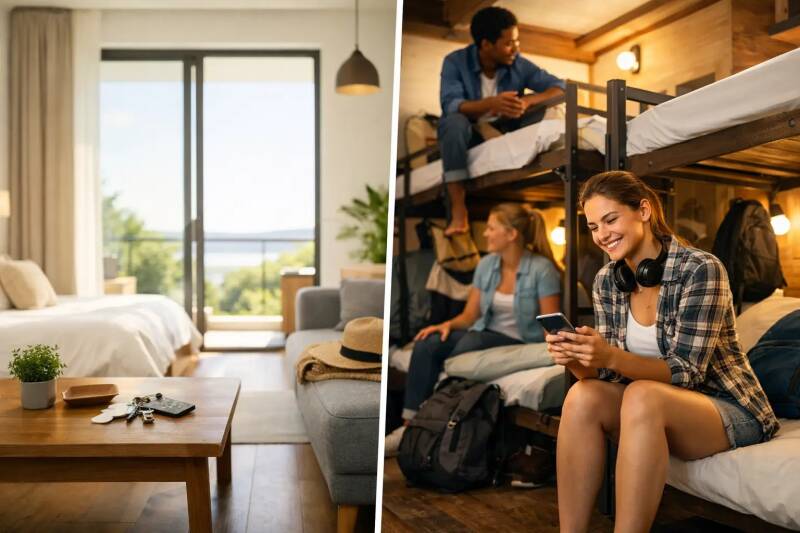
Airbnb vs hostel - compare cost, privacy, safety, location, and social vibe so you can choose the stay that fits your budget and trip style. You feel it the moment you start booking a trip. Flights are sorted, the route looks good, and then the real question appears: airbnb vs hostel. I have gone back and forth on this more times than I can count, usually with ten browser tabs open and a budget that suddenly feels very personal. The right choice can shape your whole trip - not just how much you spend, but who you meet, how well you sleep, and how connected you feel to the place.
This is not really a battle between good and bad. It is a question of travel style, energy, and what matters most on this particular journey. A hostel can hand you instant community and a lower nightly cost. An Airbnb can give you quiet, privacy, and a chance to settle into a neighborhood rhythm. Both can be brilliant. Both can disappoint if you book the wrong one for the wrong reason.
Airbnb vs hostel: what actually changes your trip?
Accommodation is never just a bed. It becomes your base when you are jet-lagged, your shelter during a rainy afternoon, and sometimes the place where the best conversations of the trip happen. That is why choosing between an Airbnb and a hostel is bigger than a price comparison.
Hostels tend to make travel feel more open. You are sharing space, overhearing plans, joining walking tours, swapping food tips in the kitchen, and often falling into spontaneous friendships because everyone is in motion together. If you are traveling solo, especially for the first time, that built-in social life can be a gift.
Airbnbs usually create a different rhythm. You come back to your own space, make a coffee in your kitchen, and hear the sounds of ordinary local life outside the window. That can feel grounding, especially on longer trips or when you need rest. If your days are packed with museums, buses, markets, or remote work, having a calm place to return to matters more than people often admit.
Cost is more complicated than it looks
At first glance, hostels usually win on budget. A dorm bed is often cheaper than a private Airbnb, particularly in expensive cities. If your goal is to stretch every dollar and spend money on food, transport, or experiences instead, a hostel is often the obvious pick.
But the cheapest option on the booking page is not always the cheapest overall. A hostel may charge less per night, yet you might end up paying for extras like towel rental, locker fees, laundry, or even a more expensive breakfast because the kitchen is too crowded to use. Sleep also has value. If a cheap dorm leaves you exhausted for three straight nights, you can feel that cost in your whole trip.
Airbnbs can look reasonable until the service fees and cleaning charges appear. That is where many travelers get caught out. A two-night stay can become surprisingly expensive once those extras are added. On a longer stay, though, an Airbnb often starts to make more sense, especially if you can cook some meals and split the cost with a friend or partner.
For solo travelers on a short city break, hostels often come out ahead. For couples, friends sharing one space, or slow travelers staying a week or more, an Airbnb can be better value than it first appears.
When the budget answer is clearly hostel
If you are backpacking across multiple cities, moving often, and mostly need a safe bed and decent location, a hostel is hard to beat. You are paying for practicality and flexibility. That matters when every transit day chips away at your budget.
When Airbnb can save money
If you are staying put, cooking regularly, or splitting costs, the math changes. A small apartment with a kitchen can reduce daily spending in ways that do not show up on the nightly rate alone.
Privacy, sleep, and personal space
This is where the biggest emotional difference usually shows up. In a hostel, privacy is limited unless you book a private room, and even then you are still in a shared environment. Doors slam. Someone packs at 5 a.m. Another person decides to take a call from their bunk. Sometimes the social energy is wonderful. Sometimes you just want silence and cannot find it.
Airbnbs are usually better for rest. You control the lights, the bathroom schedule, the noise level, and the general mood of the place. After a long train ride or a week of constant movement, that can feel less like a luxury and more like basic recovery.
I think many travelers underestimate how much sleep affects confidence. When you are tired, every small challenge feels bigger. You are less patient, less curious, and less open. If you know you get overstimulated easily, or you are heading somewhere where the days will already be intense, an Airbnb might support the trip you actually want to have.
Social life and human connection
Hostels still win this category by a mile. If you want to meet people without trying too hard, they make it easy. Shared kitchens, common rooms, pub nights, city tours, and day trips create natural opportunities to connect. That is especially valuable for solo travelers who want company for dinner, a walking buddy, or simply reassurance in a new place.
An Airbnb can be social, but only in a very different way. If you are staying in a room inside someone’s home, you may get local insight and real conversation with a host. Those moments can be memorable and more rooted in everyday life than hostel chatter. But if you book an entire apartment, you are mostly on your own.
Neither is better in every case. Hostels are stronger for meeting fellow travelers. Airbnbs are sometimes better for feeling embedded in a neighborhood rather than in the traveler bubble.
Airbnb vs hostel for location and local experience
This part depends heavily on the city. Hostels are often clustered around central, convenient, transit-friendly areas. That is useful if you want to walk to major sights, arrive late, or keep things simple. For short trips, convenience can be worth a lot.
Airbnbs often open up more residential neighborhoods. That can mean better bakeries, quieter streets, cheaper groceries, and a stronger sense of how a place actually lives beyond the postcard version. It can also mean longer commutes and fewer late-night transport options, so romance should not completely overrule logistics.
If meaningful travel matters to you, this is where an Airbnb can be especially appealing. Cooking from a local market, greeting the same café owner each morning, and noticing the normal rhythm of a block can make a destination feel less consumed and more experienced. Still, a well-run hostel with local staff, neighborhood walking tours, and a thoughtful common space can also create real connection. The category does not guarantee the experience.
Safety and reliability
Both options vary wildly, which is why reviews matter so much. A good hostel is usually very straightforward: clear check-in, secure lockers, lots of recent reviews, and staff used to helping tired travelers solve problems fast. That predictability is reassuring.
Airbnbs can feel more uneven. Some are beautifully managed and exactly as pictured. Others raise red flags only after booking. Self check-in sounds convenient until you are standing outside with weak signal and unclear instructions. For first-time travelers or late-night arrivals, that uncertainty can add stress.
Whatever you choose, pay attention to review patterns rather than one glowing comment. Look for mentions of cleanliness, noise, accuracy, neighborhood safety, and host responsiveness. If multiple reviewers complain about the same issue, believe them.
So which should you book?
If you are traveling solo, watching your budget closely, and hoping to meet people, book the hostel. If you are feeling nervous about being alone, a good hostel can change the whole emotional texture of your trip. It gives you structure without locking you into anything.
If you are traveling as a couple, staying longer, working remotely, or simply craving calm, book the Airbnb. You will probably appreciate the privacy more than you expect, especially once the novelty of being constantly out and about wears off.
If you are torn, mix the two. This is honestly one of my favorite ways to travel. Start in a hostel for the first few nights to get oriented, meet people, and gather local tips. Then move to an Airbnb when you want to slow down, do laundry, cook a proper meal, and have a little breathing room. PackLight Journeys has always leaned toward travel that feels both practical and personal, and this blended approach often gives you the best of both.
The smartest travelers are not loyal to one accommodation type. They match the stay to the season of the trip. A weekend in Lisbon, a month in Mexico City, a first solo trip through Southeast Asia, and a quiet writing week in Montreal all ask for different things. Choose the place that supports the version of travel you want to live, not just the one that looks cheapest on the screen.
Add comment
Comments